Director
Sebastián Lelio
(A FANTASTIC WOMAN)
Stars
Rachel Weisz, Rachel McAdams and Alessandro Nivola
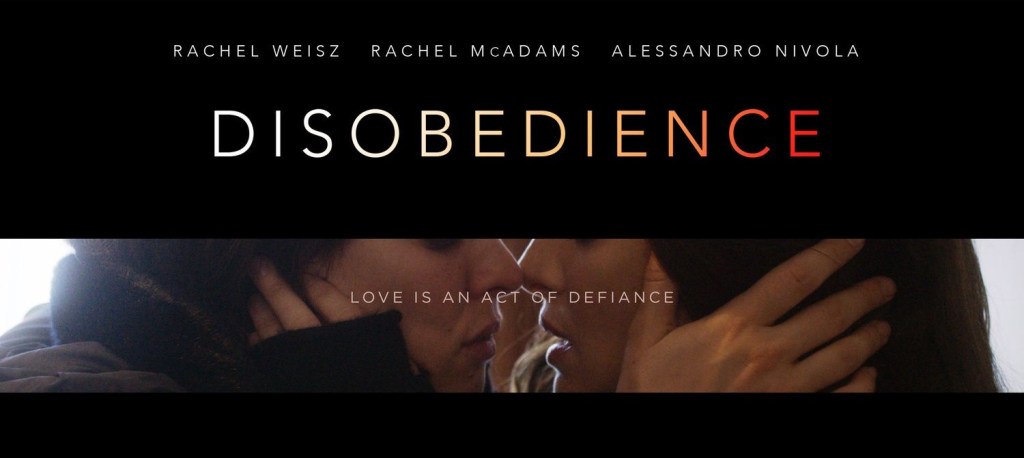
Full confession; Disobedience was one of my most anticipated movies this year, based solely on the fact that I heard it was about two Orthodox Jewish lesbians played by Rachel McAdams and Rachel Weisz, who engage in a forbidden romance. I guess you could say, ‘it had me at shalom’. Yes, I’m that shallow. I’m the person who falls for queer baiting on television…like that time I watched an entire season of The O.C. because I read that Marissa was going to ‘lez out’. But one thing I found with my Disobedience experience is that it was so much more than just a chance to see two of my favourite actresses get it on.

Disobedience tells the story of Ronit (Weisz), a New York based photographer who returns to her home in London following the passing of her estranged father, a renowned and well respected Orthodox Rabbi. Without divulging the reasons why, it’s made clear early that Ronit was not entirely welcome back in the community she had seemingly abandoned some time ago. Whilst childhood friend Dovid (Alessandro Nivola) is hesitantly welcoming, there is discernible tension when she arrives at his house following her fathers’ burial. This is also where we are introduced to Etsi (McAdams) and it becomes evident that the three of them had been close friends at one point. Ronit is noticeably surprised to learn that Dovid and Etsi are now married.
One of the weaknesses of this film is the amount of heavy lifting that’s left to the audience when it comes to filling in the blanks. A lot of the backstory of the characters is left to assumption or vague snippets of information. There is obviously a depth to the history of these characters, but the writers aren’t going to let you in on their secrets.

If you were to watch this film with no prior knowledge of it or the novel it’s based on, the relationship development between Ronit and Etsi would seem a little clunky and perhaps surprising, due to the rapid ascension of tension between them. As it turns out, the two women have an intimate history with one another, which when discovered originally, led to the estrangement between Ronit and her father, and the encouragement from the late Rabbi for Etsi to marry Dovid (his most dedicated disciple and heir apparent).
What transpires over the next few days is an exploration of self from both women; for Ronit it’s a time to reflect on what she left behind, both with Etsi and her father, and for Etsi it is the struggle to reconcile who she is when parts of herself seem to vehemently contradict her religious ideals.

What Disobedience does well, it does very well. It is an intriguing look into Orthodox Jewish lifestyle, and perhaps one of the most accurate portrayals in mainstream cinema. It also conjures genuine chemistry between the two leads, and depicts an incredibly sensual and authentic encounter between the two. The performances are convincing and encourage sympathy for the three main characters. Conversely, what it does poorly, it does very poorly and that detracts from the strong performances from its actors (particularly that of McAdams). The film, and the novel it’s based on, both have Ronit as the main focal point, however Etsi and Dovid seem far more interesting as characters. I don’t think either character is explored to their full potential.
Disobedience isn’t easy work for the most part. It’s heavy and laborious, with an atmospheric thickness to it. It will seem both slow and rushed all at the same time, and for many, the rewards might not befit the effort. But if, like me, you’re interested in empowering queer stories with added layers of cultural exploration, then it might just be worth the hard work.
3 stars
Trailer
DISOBEDIENCE
Moviedoc thanks Roadshow Films for the opportunity to view this film.
Reviewed by Jell for Moviedoc
Follow us on Facebook and Twitter
 Moviedoc
Leave a comment