Director
Peter Farrelly
Starring
Viggo Mortensen, Marhershala Ali and Linda Cardellini
Peter Farrelly’s first solo directorial project Green Book has become a perfect illustration of a division that is enveloping Hollywood at the moment. Firstly being lauded by many critics and awarded heavily at the Golden Globes in early January, the weeks following have seen criticism of the film growing louder, and even forcing one of the films’ stars to apologise to the family of one of the key subjects of the film.

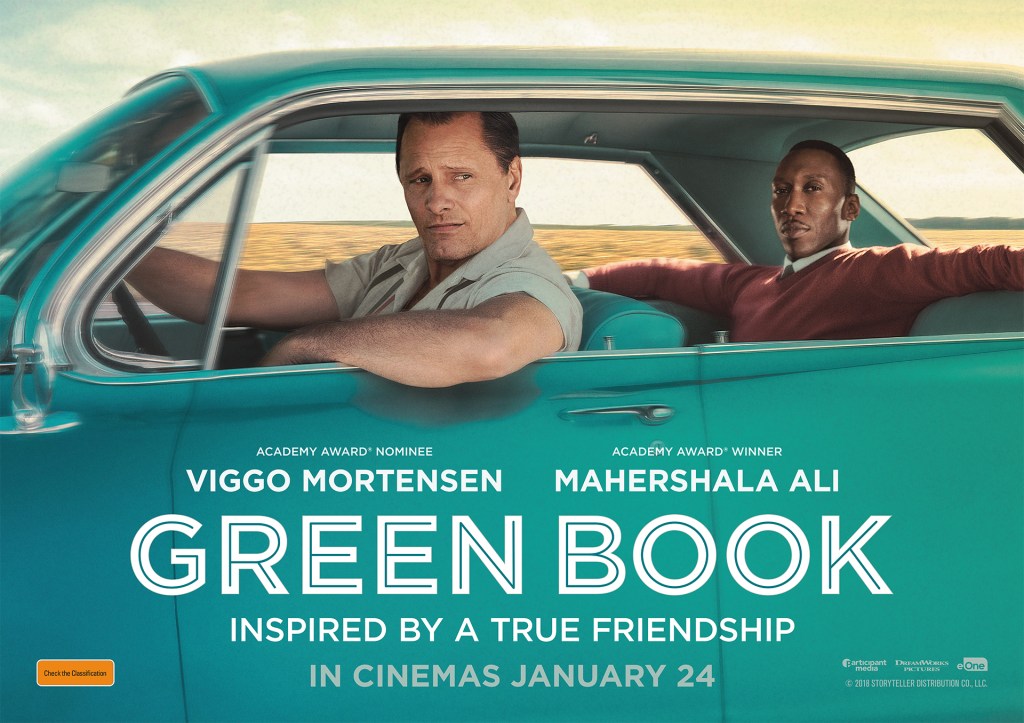
Based on a true story, Green Book tells of a road tour of renowned African-American pianist Don (Doc) Shirley and his white Italian-American chauffeur come bodyguard Tony ‘Lip’ Vallelonga, through the southern states of America in the 1960’s. The film was written by Tony’s son Nick and is essentially trying to tell the story of one man overcoming his racial prejudices. So one might ask, ‘what’s so terrible about that?’, and after delving a little into the issue, it seems there is a lot to unpack on in this situation.
Firstly there is the issue regarding the censure emanating from the family of Doc Shirley about not only the portrayal of the friendship between Doc and Tony, which they claim is overstated at best, but also the matter of consent regarding the development of the film at all. According to Doc’s family, the man himself never wanted the movie to be made; this is disputed by Nick Vallelonga however who claims that Doc gave him permission to tell the story, but only after his passing (which occurred in 2013). These claims motivated Marhershala Ali (who plays Shirley in the film) to issue an apology to the Shirley family for any offence caused by the film.

Secondly, and perhaps more importantly there is the issue of the ‘white savior trope’, whereby a non-white character is rescued by a white character who in turn learns something about themselves in the process. A much vocalised issue in Hollywood and a point of great contention, it’s obvious that films that fall into this category are no longer going to escape scrutiny, regardless of how well-intentioned or well produced the story may be. It’s true that there is a dearth of honest, warts and all portrayals of minority groups and their struggles in mainstream Hollywood films, and the continual production of this type of white savior film does nothing to remedy that. But does that mean there is no place for these stories at all? See this is where I become conflicted; I fall into a number of marginalised groups myself, however I am still white, so at which point do I need to check my privilege? As someone who grew up in a multi-racial extended family, I always enjoyed seeing films that showed the coming together of opposites to overcome diversity, as it reflected a sameness that I saw in my interactions with my own family. But by not examining that further, it never occurred to me that all of these films followed a very similar and problematic narrative.

A lot of the films that fall into this category are based on true(ish) events; think Remember The Titans, Glory Road, Mississippi Burning, The Blind Side and Dangerous Minds, which makes some people argue that you can’t change the figures of history to aid diversity. The retort to that however is that you CAN change which stories are being told, or at the very least the way the story is told and the perspective of the journey, and THAT is main issue with Green Book.
Here we have a snapshot into the life of one of the most interesting African-American musicians of the 1950’s and ‘60’s, but the main protagonist is a white chauffeur. The story is his journey, not Shirley’s. Granted this film was written by Vallelonga’s son, so of course it’s going to originate from that perspective, but what was to stop the producers from expanding on that idea to detail Shirley’s journey? I can tell you that that would have made one hell of a story and would have added depth where it was at times lacking. Not only could the story have delved into the racial divisions within the U.S at that time, but Shirley himself as a black, queer, classically trained pianist has enough material in his life to make ten movies. There could have been further exploration on the need for the films’ title source ‘The Negro Motorist Green Book’, which was a guide relied upon by African Americans for some three decades to navigate travel routes and accommodation that was safe for them to stay in. This wasn’t explored nearly enough for a film that’s named after it. There was so much left untouched in a film that could have said so much.

Now that all being said, here’s the twist where I’m going to contradict myself entirely, because at the end of the day, I LOVED this movie. Yes I see why it’s problematic, and don’t for one minute want to dismiss these issues, because they are very real and important. But there is a charm about his movie that is infectious and the performances of Ali and Viggo Mortensen are captivating. Ali will almost certainly win his second Oscar for his role, and Mortensen would be in contention almost any other year. It’s kind of like a trashy TV show that you hate yourself for enjoying, but this time with greater consequence. I don’t think that there’s been a movie that’s made me question by social conscience before like this has. Walking out of the film and knowing a bit of the criticism surrounding it, I felt genuine discomfort in the fact that I enjoyed it so much, and I know that makes me part of the problem.
So after some consideration, I’ve decided not to give a rating to this film. It’s not for me to lecture people on what they should or shouldn’t feel about Hollywood narratives, and I would be a hypocrite to chastise a film that I actually enjoyed (despite my latent guilt). So instead I encourage you all to make a decision on your feelings about this subject yourselves. As is the case with most things in life there are both great and not-so-great aspects to the production of Green Book.
Trailer
GREEN BOOK
Moviedoc thanks Entertainment One for the invite to the screening of this film.
Follow us on Facebook and Twitter
 Moviedoc
Leave a comment