
Directed by Sarah Polley
Starring Rooney Mara, Claire Foy, Jessie Buckley, Judith Ivey, Sheila McCarthy, Michelle McLeod, and Ben Whishaw
Should Women Talking wholly deserve to win an Oscar at this year’s Academy Awards ®, it won’t be in one of the two categories – Best Adapted Screenplay and Motion Picture, it is nominated for. In fact, the field I am referring to is non-existent!
Based on a 2018 novel of the same name by Canadian writer Miriam Toews, which the author herself describes as an imagined response to real events that took place in Bolivia, Women Talking is set almost entirely inside a barn where the women of an isolated colony meet to make a crucial and imminent decision.
For two days, these women are without the men who control all proceedings at the colony. It’s a change in circumstances that has happened for reason but has happened out of the blue. This prompts an urgent meeting where the women hold a plebiscite to decide their future. The outcome is a tie – do they stay and fight back, or do they leave?
This is where my Oscar suggestion comes in. Virtually the entire duration of this film chronicles the discussions and arguments surrounding the risks, pros, cons, and consequences of both decisions. And the Oscar for the film that stays most true to its title goes to… *opens envelope*… Women Talking.
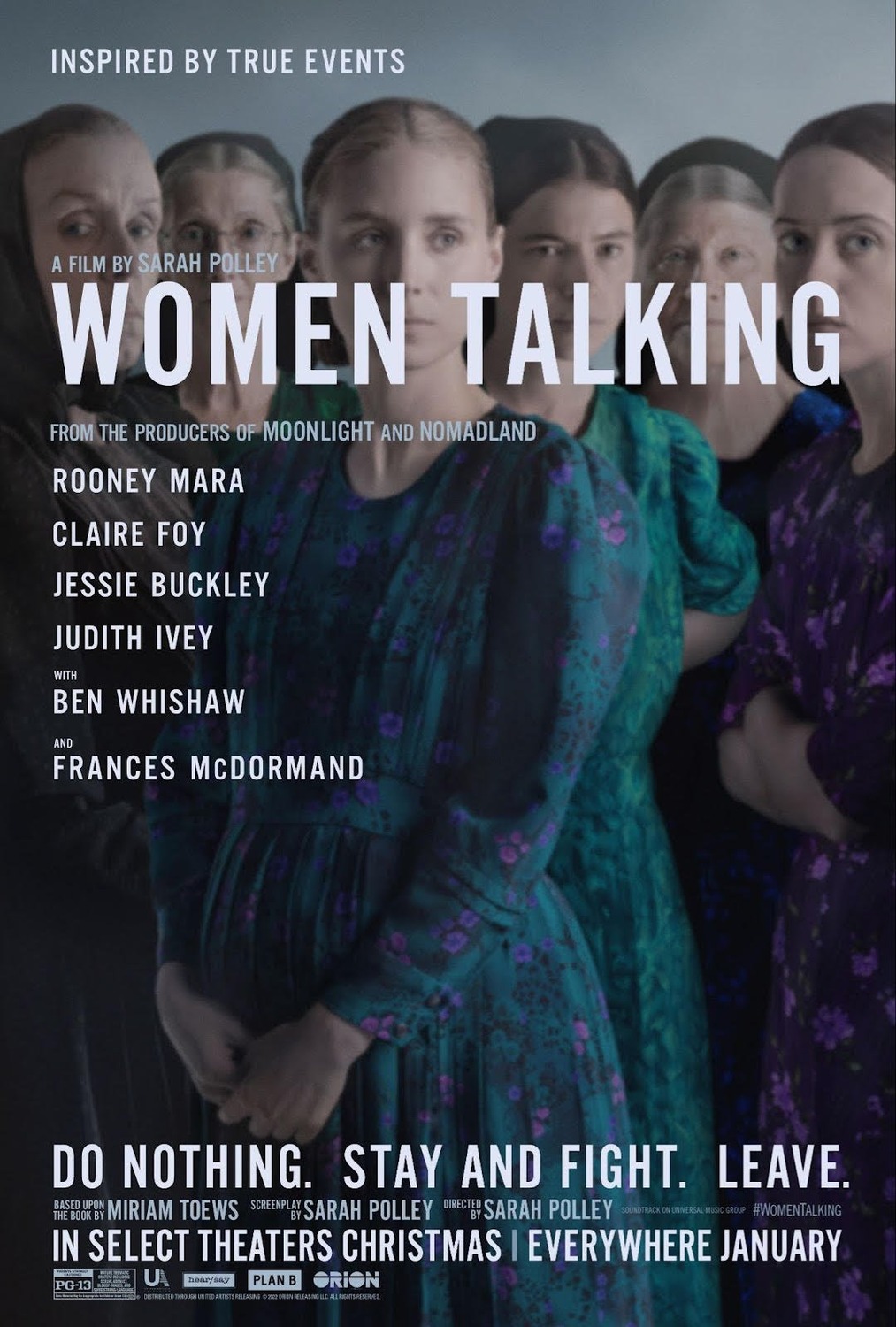
Even though this format will test the patience of most viewers at times, the film isn’t without intrigue and its ensemble of characters, a small handful of which are played by the very talented and appealing big names you see on the poster above, aren’t without depth and difference. Ona (Rooney Mara) is cool, calm, and collected throughout the conversations. A relatively freethinker for someone who’s been living in a colony all her life that thoughtfully questions what others say, sees a number of avenues for change and allows herself to change her mind on matters. Salome (Claire Foy) on the other hand is angry, very angry, and firmly believes there is no other option but to leave. Mariche (Jessie Buckley) is also angry and clashes with others but is ostensibly deeply tied to something or someone keeping her at the colony.
Despite these differences in personality, temperament and opinion, the common denominator of these women is the fact they are all victim survivors of torrid male abuse and know this is their one and only chance to do something that will finally change that.

For some, if not all of these women, leaving their abusers and the abuse also means leaving the only life they know and raises certain logistical complications that must be addressed. Staying and fighting challenges views on their faith and means their salvation is at stake. Literally generations of women reside here. The film definitely succeeds at justifying why this critical decision is almost an impossible one that needs the entire film duration to be nit-picked at from all sides.
Performances across the board are stirring. Rooney Mara is convincing and rock solid, Jessie Buckley uniformly strong and effective, Claire Foy again excels and continues to diversify her skills set and Ben Whishaw, who plays the colony teacher August is very emotive. However, I was equally, if not more, impressed by a few of the lesser-known cast members in this film. Sheila McCarthy, Michelle McLeod, and Judith Ivey all lend a significant contribution to proceedings and never look out of place or inferior to the heavyweights they act alongside. Women Talking certainly boasts one of the greatest female ensembles on paper and screen we’ll likely see in 2023. If you’re wondering why I’ve made no mention of Oscar-winning actress Frances McDormand, that is because her appearance here is fleeting. I can’t help but feel an actress of her calibre would only have been of benefit to the film had her services been utilised more than what’s been chosen.
Due to personal circumstances in my own life, any film or documentary that depicts or is set within any type of colony, religious sect or cult is immediately of huge interest. My recent review of NZ documentary Gloriavale is one example of that. Add the incredible cast, the Oscar buzz, and the true story connections to the list for this film and you can hopefully appreciate my eagerness and anticipation to see Women Talking.
It therefore is a pity to admit I left the cinema somewhat underwhelmed by what I just saw. A part of that can be attributed towards the format I’ve discussed in this review already, but a more immediately identifiable reason is the distinct lack of tension felt. Tension is certainly written all over the faces of these women and is omnipresent in the eloquent and powerful dialogue being exchanged between them. Yet somehow, director Sarah Polley hasn’t been able to seamlessly integrate that tension into her film’s inescapably repetitious structure. As a final and more positive side note though, the colour grading Sarah Polley opts for in this production lends her film a grim yet striking appearance.
Women Talking is showing in cinemas across Australia from February 16th.
Moviedoc thanks Universal Pictures for the invite to the screening of this film.
Review by Leigh for Moviedoc
Follow on Twitter – Moviedoc / LIKE on Facebook – @moviedoc13 / Follow on Instagram – moviedoc_melbourne
©


Leave a Reply