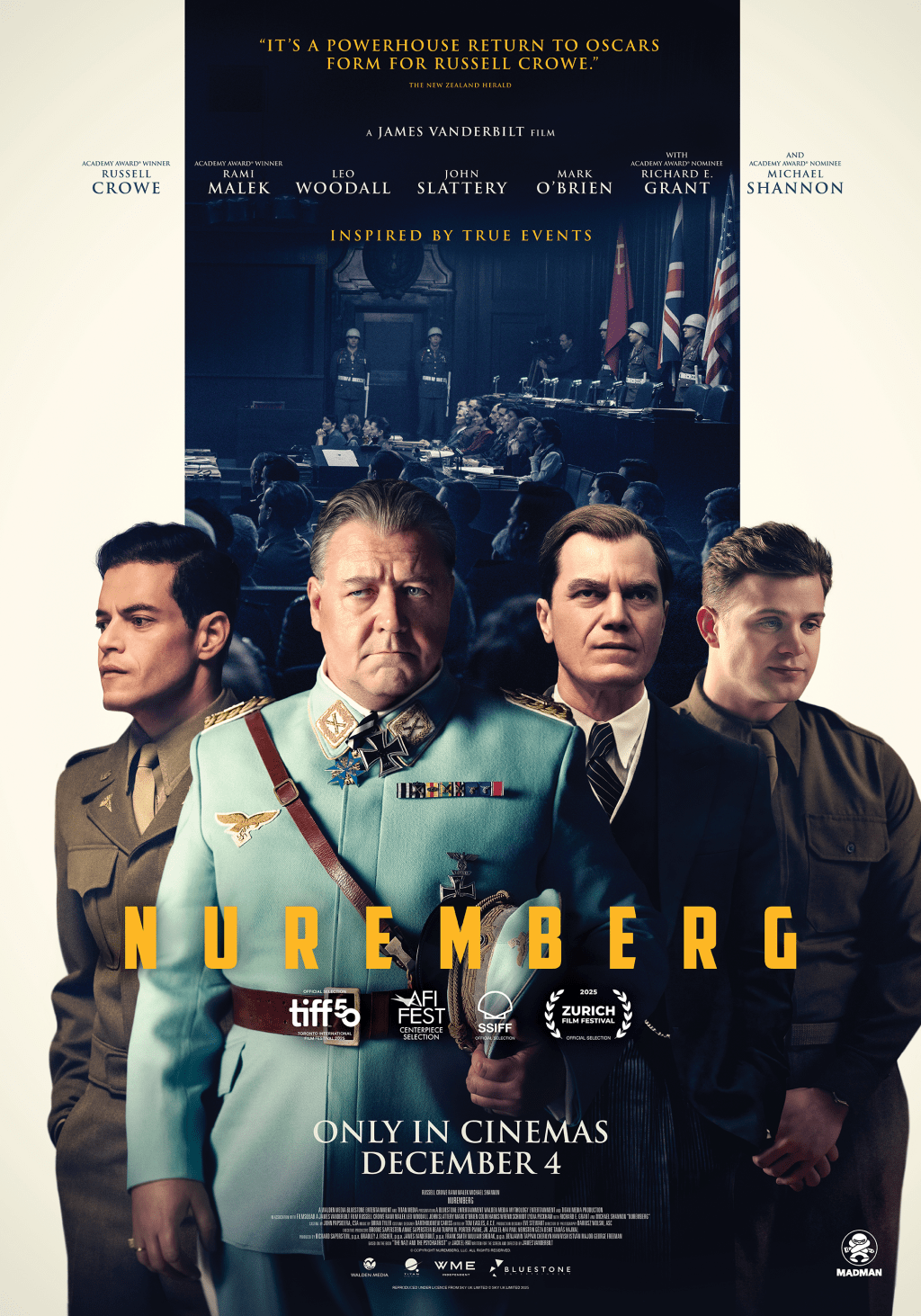
DIRECTOR
James Vanderbilt
Truth
STARS
Russell Crowe, Michael Shannon, Rami Malek, Leo Woodall, Richard E. Grant and John Slattery
Of all the WWII films I’ve viewed, I struggle to think of one quite like Nuremberg.
A war film whose characters are not armed with weaponry to mercilessly kill, but whose weapons are their wit to stop the merciless killing that’s already been done from ever happening again. And one who uses their wit to evade responsibility and conviction!
Based on the 2013 non-fiction book The Nazi and the Psychiatrist by Jack El-Hai, it is the final day of war in Europe, May 7th, 1945. As we know by this date, Adolf Hitler is dead after cowardly taking his own life. This leaves Hermann Göring (a surprising and at-first questionable casting choice in Russell Crowe) as the face of the Nazi High Command. When he is captured by Allied Forces, Washington D.C based Supreme Court Justice Robert H. Jackson (Michael Shannon) must immediately travel abroad and rapidly establish a way to have Hermann Göring be tried in a court of law. This is a landmark case though that requires continental cooperations and formal endorsements to proceed. With the assistance of Howie (Leo Woodall), a Sergeant and interpreter, Robert summons Psychiatrist Douglas Kelley (Rami Malek) to evaluate Göring and assess his mental state of mind in the lead-up to the trial. Douglas is smart and ambitious, seeking to utilise his client to understand how men become monsters and how to psychologically define true evil, but has met his intellectual match in Göring.
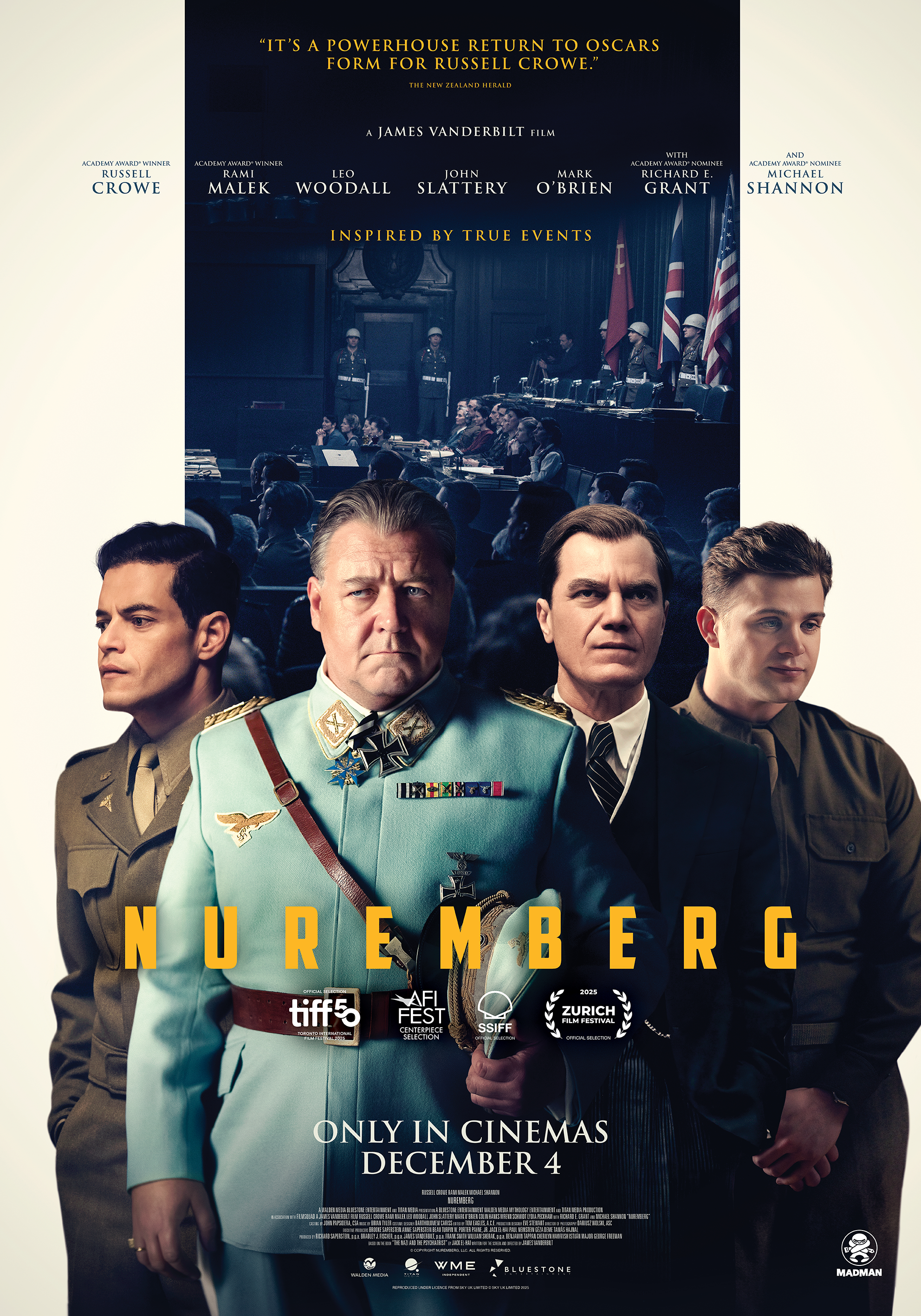
Nuremberg boasts a magnificently multi-faceted screenplay that is a sumptuous psychological feast. It is immediately completely captivating, a characteristic it maintains and progresses all throughout, along with its sheer clarity in script writing. One of the greatest assets of this film are the various aspects of its story, how each of these are expanded and connect with the ultimate goal – to make a war criminal accountable and bring some form of justice to such tragic loss of life. Despite being the one behind bars in a secret military prison, Hermann Göring assumes a position of control over his shrink and is more than willing to engage in a battle of wits with his prosecutors. This is incredibly fascinating stuff. The preparations to form a world first international tribunal, led by Robert, successfully convey the complexities, conundrums and uncertainties that are encountered and validate the significance of each central and supporting character in the courtroom once we get there. That includes the British lead prosecutor, Sir David Maxwell-Fyfe (Richard E. Grant) and extends to characters not present in this setting too, such as the involvement of Göring’s wife and daughter. The role that Robert needs and asks Douglas to play evolves and Douglas’ intentions become broadly questioned – where does he draw the line in potentially making groundbreaking psychological discoveries and advancements and what could this mean for his professional career and personal ambitions versus how far will they remove him from or hinder the reasons he is in this position to begin with? It is a screenplay that is just so brilliantly layered and is always articulated with outstanding clarity.
◊◊◊◊◊
Characterisation is another suit as strong in appearance as the one Crowe’s cunning and unmistakably cruel character dons. Early on, the writing lends some light-hearted dialogue his way and together with Russell Crowe’s performance (more on that in a moment!), briefly enables viewers a glimpse of the less monstrous side of Hermann Göring. A side one could say is even capable at charming someone such as his wife, or even his psychiatrist! Though technically Douglas should always have the upper hand, some of his vulnerabilities become apparent to Göring. This adds another layer to the many character dynamics on show in this great film.
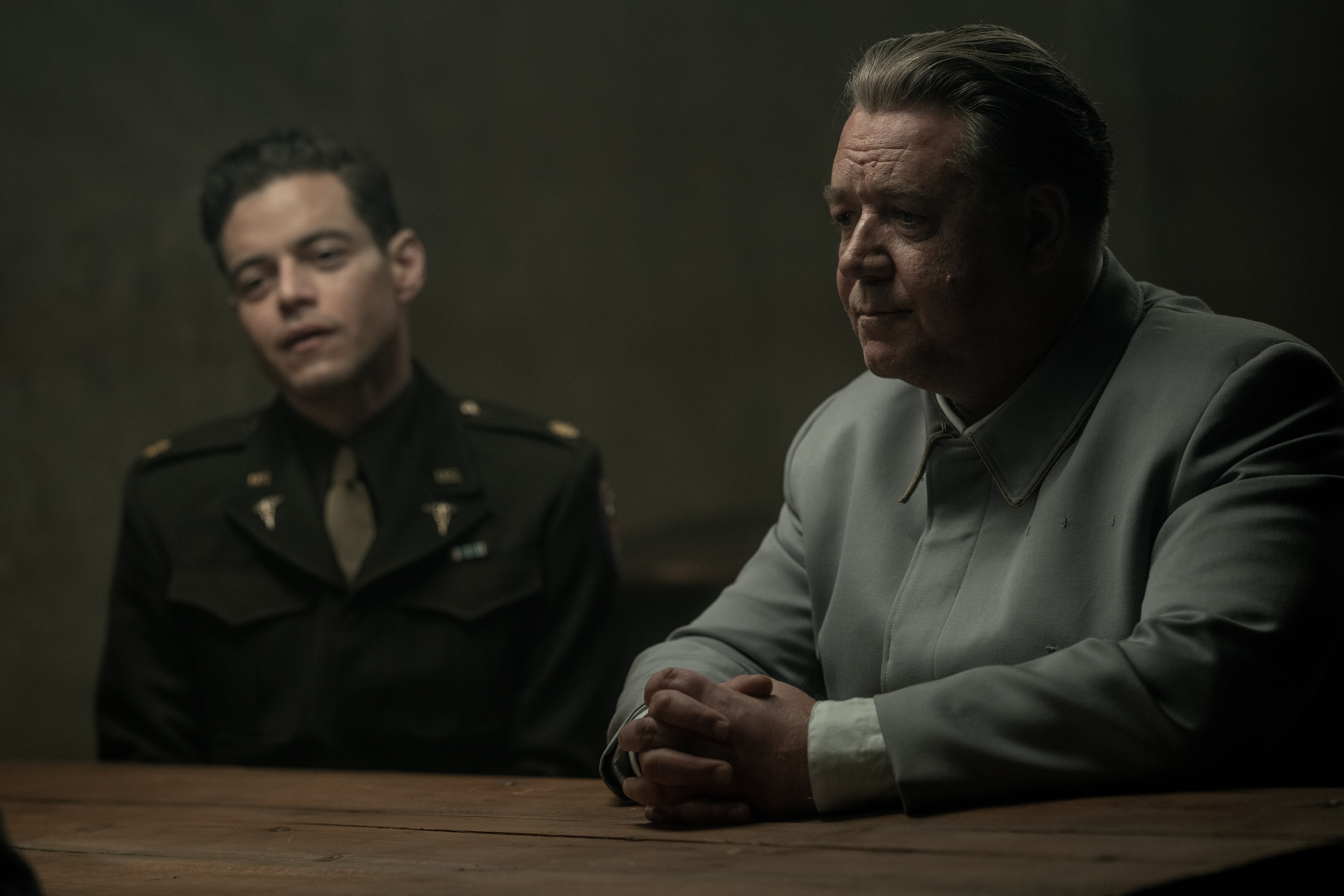
Nuremberg is also a film of many fine performances. I could easily provide a mini spiel for each of the actors mentioned below ‘Stars’ atop this review. Instead, I will mention 3 of those 6 performers. Firstly, Leo Woodall’s work could easily be overshadowed by the star power he acts among and considering the much leaner body of work in his resume to date. He is simply brilliant, however, and deserves utmost recognition for what he pours into his pivotal role in the film. Oscar winning actors Rami Malek and Russell Crowe absolutely and inevitably own Nuremberg on the performance front. The subtle shifts in eye contact and expression Malek must execute when in Crowe’s presence, which is thankfully often, are especially mesmerising to watch. As for Russell Crowe, this is a towering performance as Hermann Göring that is his best since his third and last Oscar ® nomination in A Beautiful Mind. Perhaps my German husband will be the better judge than I of just how authentic Russell Crowe sounds when speaking Deutsch, and when speaking English with a consistent German accent, but it sounded largely genuine to me. One thing to note, however – I do acknowledge the decision to cast Russell Crowe over a German actor, or at least one who does speak fluent German, is dubious, given the real Hermann Göring spoke rudimentary English at best. A part of me does wonder just how much more powerful scenes with Göring could be if they were translated to English as they mostly were in real life, and which actor might be the best fit to portray him. Irrespective, and foreign languages and accents aside, what stands out in Crowe’s performance is his precision in execution and timing which characteristic of Hermann Göring to reveal. It left me in awe in certain moments.
◊◊◊◊◊
Importantly, the production is understated throughout and does not ever interfere with or attempt to over-dramatise or outdo the screenplay and storytelling. Some may find the gentle pacing over 2 and a half hours slower than needed, but considering the weight of the content, the pacing was perfect as it allowed important details to be absorbed. Moments shot in black and white during courtroom scenes add some artistry to the production and are very effective, and footage from concentration camps shown publicly for the first time to the court are extremely harrowing. Do ready yourselves for that.
◊◊◊◊◊
Finally, Nuremberg makes itself globally relevant to today courtesy of its precise and paramount messaging. We are kidding ourselves and not learning a darn thing from history if we allow ourselves to be driven by hate and do not individually and collectively stand-up against it quickly.
Nuremberg is showing in cinemas across Australia from December 4th, 2025.
Moviedoc thanks Madman for the invitation to the screening of this film.
Review by Leigh for Moviedoc
LIKE on Facebook – @moviedoc13 / Follow on Instagram – moviedoc_melbourne
©
 Moviedoc
Leave a comment